
AI video models
MAGI-2 vs Seedance 2.5: clip cost and limits (Nov 2026)
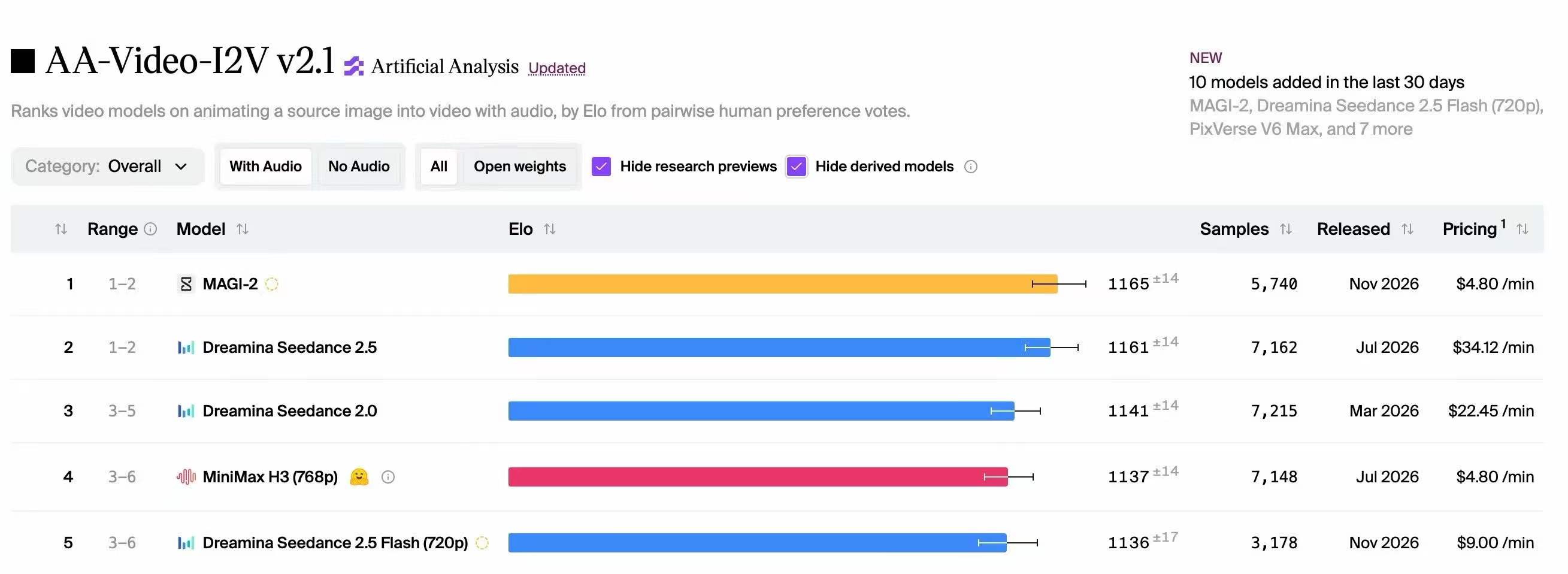
MAGI-2 leads the supplied image-to-video ranking by four Elo points and lists at $4.80 per minute against $34.12 for Seedance 2.5. Here is how to compare price, retries and production fit.
TL;DRCompare approved clips, not just the rate card
- MAGI-2 has 1,165 Elo in the supplied AA-Video-I2V v2.1 snapshot. Seedance 2.5 has 1,161, so the score difference is only four points.
- The same snapshot lists $4.80 and $34.12 per minute. That is a 7.1 times difference in listed price, before retries and editing.
- A separate Chinese hosting offer quotes CNY 0.5 per second for MAGI-2. Its claimed one-tenth comparison belongs to that offer, not to the dollar prices on the leaderboard.
- MAGI-2 supports up to 30 seconds at 1080p and 25 fps, with synchronized audio. Sand.ai documents motion, animation and complex sound as remaining limitations.
MAGI-2 makes a strong case on price, but a four-point Elo lead does not tell you which model will finish your next ad. The useful comparison is the full cost of a clip you can approve: generated seconds, failed takes, correction time and any separate voice or editing work.
What does the ranking actually show?
The supplied Artificial Analysis AA-Video-I2V v2.1 leaderboard ranks models on human preferences for animating a source image into video with audio. MAGI-2 is first in this view, with 1,165 Elo and an uncertainty of plus or minus 14. Dreamina Seedance 2.5 is second with 1,161, also plus or minus 14. Their plausible ranges overlap, and the chart labels both first and second place with the same range of 1 to 2.
This is useful evidence of preference in one image-to-video evaluation. It is not proof that MAGI-2 wins every prompt, every language or every production task. Sand.ai also reports a four-task average of 1,150.3 Elo across I2V, silent I2V, T2V and silent T2V in Video Arena v2.1. Those are different aggregations. Do not substitute the average for the 1,165 score shown in the image above.
| Model | Elo in the supplied I2V view | Samples | Listed price per minute |
|---|---|---|---|
| MAGI-2 | 1,165, plus or minus 14 | 5,740 | $4.80 |
| Dreamina Seedance 2.5 | 1,161, plus or minus 14 | 7,162 | $34.12 |
| Dreamina Seedance 2.0 | 1,141, plus or minus 14 | 7,215 | $22.45 |
| MiniMax H3 (768p) | 1,137, plus or minus 14 | 7,148 | $4.80 |
| Dreamina Seedance 2.5 Flash (720p) | 1,136, plus or minus 17 | 3,178 | $9.00 |
Resolution and included audio can change a bill. MiniMax H3 and Seedance 2.5 Flash are shown here at different output tiers, so the table is a price snapshot, not a controlled quotation for an identical job.
How much does a usable clip cost?
Start with seconds multiplied by the price for your actual provider. Then multiply by the number of attempts. Add editing or regeneration work when only one part of a take needs to change. This gives you a number you can compare with your production budget instead of a generic claim about being cheaper.
The calculation below uses $4.80 per minute for MAGI-2 and $34.12 per minute for Seedance 2.5, exactly as shown in the leaderboard. Each row assumes every attempt generates the full requested duration.
| Requested output | Attempts | MAGI-2 at $4.80/min | Seedance 2.5 at $34.12/min |
|---|---|---|---|
| 20 seconds | 1 | $1.60 | $11.37 |
| 20 seconds | 3 | $4.80 | $34.12 |
| 30 seconds | 1 | $2.40 | $17.06 |
| 30 seconds | 3 | $7.20 | $51.18 |
| 60 seconds, assembled from separate clips | 3 per clip | $14.40 | $102.36 |
For example, three 30-second attempts at the listed MAGI-2 rate cost 1.5 minutes multiplied by $4.80, which is $7.20. Three attempts at the Seedance 2.5 rate cost $51.18. These are estimates from the displayed rates, not quotes from either company. Taxes, minimum charges and provider markups are not included.
The Chinese reports give a different hosting reference: CNY 0.5 per second on LibTV. At that rate, a 20-second generation is CNY 10 and a 30-second generation is CNY 15. Three 30-second attempts cost CNY 45. For one hour of generated source material with three attempts at every second, the arithmetic is 3,600 multiplied by CNY 0.5 multiplied by 3, or CNY 5,400. That hour is raw footage, not a finished one-hour episode.
Use one formula for your own jobs: generated seconds x attempts x provider rate + correction costs = cost per approved clip. Record a rejected take even if you never download it. It still consumed the budget.
What do the official demos show?
The Chinese source reports include paired advertising tests using the same references and prompt on MAGI-2 and Seedance 2.5. Their video narration is in Chinese, so those examples are not included in this English edition. The two demonstrations below come directly from Sand.ai's English release and do not contain Chinese dialogue. They are not head-to-head model comparisons.
The first moves through five painting styles in one continuous take. Watch the subject and the camera during the transitions. A style can change successfully while the scene loses its spatial logic.
The second is the official precision timeline and shot-cut example. Use it to inspect the event at each timestamp and the continuity between shots. That is more useful for a production decision than an attractive montage without the prompt or timing.
For your own comparison, use the same reference files and acceptance checklist with both models. Include a product close-up, a shot with dialogue and a difficult transition. The source reports favor MAGI-2 in some commercial tests, but that is their editorial judgment, not a measured win by rikoko.
Where does MAGI-2 still need work?
Sand.ai's own November 24 release lists motion and sound limitations. Extreme high-speed movement can produce trajectory or continuity artifacts. Medium and wide shots in 2D animation can make small local movements look too smooth. Complex soundscapes need better layering and physical realism.
The company also distinguishes its pre-trained checkpoint from the post-trained model. In its probes, the pre-trained model showed early signs of visual reasoning, implicit story completion and cross-lingual instruction following with prompt enhancement off. Those behaviors became harder to elicit after post-training on several thousand curated clips, while visual polish improved. Sand.ai calls this a working hypothesis, not a settled explanation.
A third-party tester reported that action scenes needed detailed movement instructions and that overly complex prompts could deform motion. That observation is useful when designing your test set, but it is not a measured success rate. The reported claim of more than 90% usable outputs also lacks a public test protocol in the materials reviewed, so this article does not use it to estimate your costs.
| Requirement | MAGI-2 evidence to check |
|---|---|
| Longer continuous shots | Up to 30 seconds at 1080p and 25 fps in the official specification. Inspect the final seconds for identity drift. |
| Many references | Up to 20 items: 10 images, 5 videos and 5 audio clips. Give every asset a distinct role. |
| Dialogue and sound | Native audio-video generation with lip sync, foley, ambience and music. Check intelligibility and whether the audio follows your reference. |
| Planned cuts | Timeline and shot-cut controls. Check the requested event at its timestamp, not only the general look. |
| Repairs | Targeted video editing is supported in the official product description. Test whether the edit preserves approved parts of the take. |
| Fast motion and 2D movement | Documented limitations. Include these cases before committing to a batch. |
Which model fits your production?
Choose from the work, not from a blanket winner. At the listed per-minute rate, MAGI-2 makes repeated long-form experiments easier to justify. Seedance 2.5 remains worth testing when its particular rendering or motion behavior saves enough correction time to justify its higher generation bill.
| Your job | Where to start | What would change the decision? |
|---|---|---|
| Several versions of a product ad | MAGI-2 for the first batch | Product inconsistency or repeated narration repairs can erase the lower unit cost. |
| A single difficult hero shot | Run both with the same image and prompt | One approved take can matter more than the price of several rejected ones. |
| Multi-scene reference-based work | MAGI-2 for the 30-second and multi-reference test | Check whether character, wardrobe and timing controls work with your actual assets. |
| Fast action or detailed 2D animation | A small controlled test before any batch | Sand.ai documents limitations in both categories. |
| A model already available in your workflow | The model you can access and bill predictably | A leaderboard score does not create access, local support or a service agreement. |
For a reference-led project in rikoko, keep your approved stills and prompt in the project, specify which model each shot should use, and inspect the estimate before submitting. The rikoko web app gives you a place to organize that brief and review the generated footage. MAGI-2 availability is not implied by this article.
How should you run a fair test?
- Choose three jobs you actually produce. Include one ordinary product shot and one known difficult case.
- Use the same reference files, duration, aspect ratio, dialogue and editing instructions for both models. Keep prompt enhancement consistent.
- Run the same number of attempts with the same selection rule. Do not show the best result from one model and the first result from the other.
- Score identity, product geometry, movement, prompt events, dialogue and final-second stability separately.
- Record every charge and every minute spent repairing a take. Divide the total by the number of clips you would publish.
Keep the prompt and seed where the service exposes them, along with the provider and generation date. That record makes an unexpected success repeatable. It also helps you see whether a model is improving your work or simply producing attractive examples.
How can you budget a video project with rikoko?
If you want to apply the same cost discipline to your next project, rikoko lets you develop a brief around your own references and review the estimated generation cost before submitting a job. You can compare the estimate with the number of approved clips you need, then include any retakes in the project budget. Check the video pricing page for current model rates and credit options. The estimate for a job depends on its selected model, resolution and duration; it does not add MAGI-2 to the available model list.
Frequently asked questions
Is MAGI-2 better than Seedance 2.5?
It leads the supplied image-to-video preference ranking by four Elo points, with overlapping uncertainty. That is a narrow result in one evaluation. Your references, shots and approval rate should decide the production choice.
Is MAGI-2 one-tenth the price of Seedance 2.5?
That is the reported comparison for a Chinese LibTV offer. In the supplied Artificial Analysis chart, $4.80 against $34.12 per minute is about 14.1%, or roughly one-seventh. Use the prices and currency from the service you intend to pay.
Can MAGI-2 generate a 30-second video with sound?
Sand.ai specifies up to 30 seconds at 1080p and 25 fps with native audio-video generation. It also supports six aspect ratios. Review the full duration, especially the ending and spoken audio.
Can it use reference videos and audio, not only images?
Yes. The official specification allows up to 20 media items per native request: 10 images, 5 videos and 5 audio clips. That is the full model's documented limit, not the limit of the older open Preview.
Can I choose MAGI-2 in rikoko now?
This review does not announce a rikoko integration. Check the model choices shown in your current workspace before planning a job.
An English editorial synthesis of Sand.ai's November 24, 2026 release and November 25 reports by AI Product A Ying, Founder Park and ZPedia. The leaderboard image was supplied for this review. Official and third-party media is identified in its captions; no generation benchmark was run by rikoko for this article.