
H3 Flex Research, from 50 steps to six
A man takes a drink on a bench. In one version he faces a lawn. In the other he faces a bowling lane. The H3 Flex research team used this edit to show how much of a shot survives a change of setting.
All articles
All topics
19 articles
No articles found.
On this page
Follow the bench through the cut
In the source footage, a man in red shorts raises a bottle beside a bowling green. The camera cuts behind him and a white tent comes into view. In the edited version the action moves indoors. Both shots survive the edit, down to the pause before he lowers the bottle.
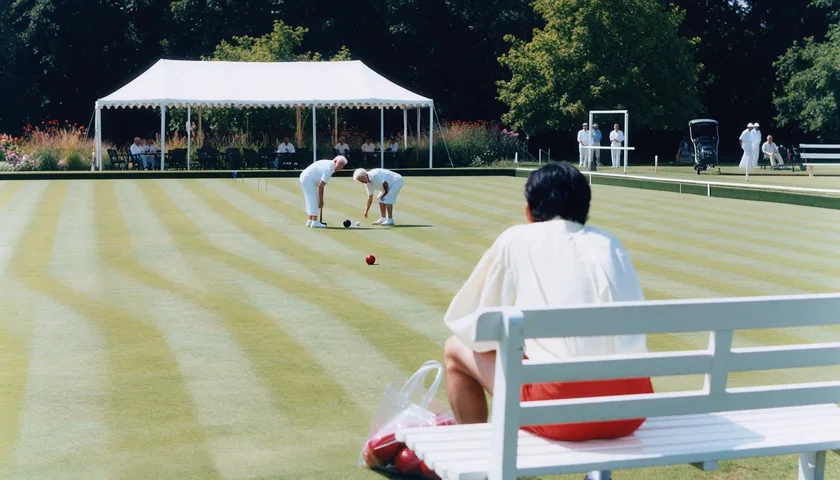 Source footage
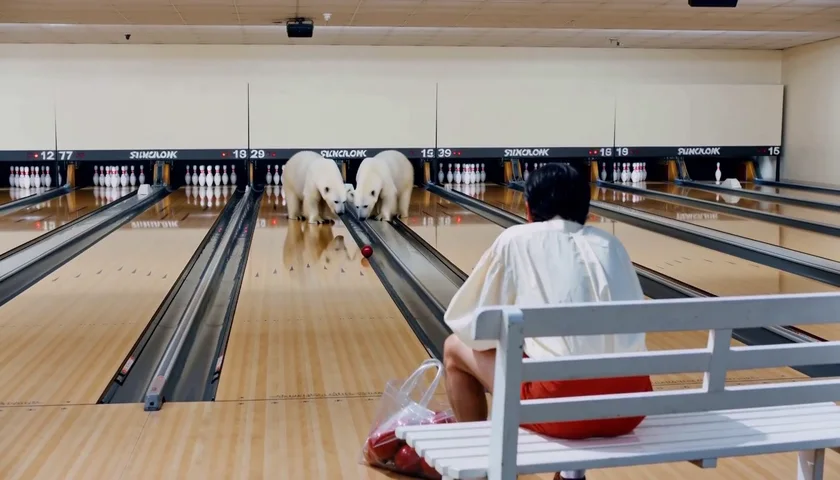 Edited footage
Look past the bench. On the lawn, the eye follows the ball across an open field. Indoors, the lane markings draw the eye toward the pins. The cut still makes sense because the seated man faces the action from the same side in both versions.
How the team trained a six-step model
The researchers began with MiniMax H3 and fine-tuned it on selected clips with sound. This became the teacher. It refined a noisy starting point 50 times to make a clip. Through a technique called projected distribution matching distillation (PDMD), they trained a student to generate picture and sound together in six updates.
The team then trained two small adapters. One rewarded visual clarity and aesthetics (ReFL). The other learned from pairs of outputs judged on qualities such as realism and how closely they followed the request (DPO). The researchers merged the adapters so that a viewer’s request still takes six steps. Read the methods in the technical report
What took 2.129 seconds?
The researchers timed one job on eight NVIDIA B300 GPUs. The input was text, the output was five seconds of 768p video with sound, and the same six-step model ran both times.
| Test configuration | Time |
|---|---|
| Before runtime optimizations | 3.409 s |
| After runtime optimizations | 2.129 s |
The 1.60× speedup in Figure 2 came from changes to how the GPUs compute attention and exchange data. If you time an API request from your own machine, record the wait for the job and the download separately. Those intervals answer a different question from the one in this table. See Figure 2 and its test conditions
What the blind tests picked up
In the published study, four models rendered the same prompts at 768p. Reviewers saw pairs of clips without model names. For text- and image-driven clips, they favored Flex on anatomy, complex compositions and sound synchronization. Other models won preferences for physical behavior, lighting and stories that needed to carry across scenes.
Even sound has more than one score. In Table 3, Flex scored 7.02 for audio aesthetics against 6.89 for Fal H3 Max. For audio–video alignment, the order flipped (0.212 and 0.216). A pleasing soundtrack and a sound that lands exactly with an action are two separate judgments. Compare Table 3 with the blind ratings in Figure 4
Try the edit on a cut of your own
Choose a two-shot clip with one person and one object that stays in view across the cut. Ask for a new location. Pause on either side of the cut and record three things separately: where the object sits, which way the person faces and when the sound of the action lands. The open model produces 480p or 768p video with stereo sound. Keep the native output for this comparison.
Model weights · Inference code