
AI video models
MAGI-2 open weights: what is available now (Nov 2026)
The full MAGI-2 weights are still promised. The Apache 2.0 Preview is downloadable today, with 114B parameters, 10-second output and a reference setup using eight Hopper GPUs.

TL;DRThe flagship and the Preview are different releases
- Sand.ai released the 480B MAGI-2 flagship on November 24, 2026. Its release says full weights and a detailed technical report will follow.
- The downloadable model today is MAGI-2 Preview, an Apache 2.0 research release with about 114B total parameters and about 6B active per token.
- The Preview generates 10-second video with sound from text or a still image. The flagship supports up to 30 seconds and mixed image, video and audio references.
- The Preview reference installation calls for eight NVIDIA Hopper GPUs and about 307 GB of downloaded components. The flagship has no published local hardware recipe in the material reviewed.
A launch headline saying "open source" is easy to read as "download the flagship now." Sand.ai's own documentation draws a more useful line: MAGI-2 Preview is available, while the full MAGI-2 release is still to come. If you are planning a deployment, those are two different bills and two different capability sets.
Can you download MAGI-2 today?
You can download MAGI-2 Preview from the Sand AI organization on Hugging Face. The model metadata lists Apache 2.0. The companion repository, SandAI-org/MAGI-2-preview, contains the reference inference code and also uses Apache 2.0. The full flagship weights were not present in that model listing when checked on November 25, 2026.
Sand.ai says it will "open-source MAGI-2" and publish a comprehensive technical report. Until the flagship files, license and inference instructions are released, the accurate description is a planned open release. The existing Preview should not be presented as if it were the new 480B checkpoint.
| Question | MAGI-2 flagship | MAGI-2 Preview |
|---|---|---|
| Release | November 24, 2026 product release | August 2026 research release |
| Backbone | 480B total, about 28B active per token | About 114B total, about 6B active per token |
| Pre-training data | 4T tokens, about three times Preview | The flagship's comparison baseline |
| Output | Up to 30 seconds, 1080p, 25 fps with audio | 10 seconds with sound; a refiner supports 1080p delivery |
| Inputs | Text plus up to 10 images, 5 videos and 5 audio clips | Text, or text plus one still image |
| Weights | Promised in the official release, not found in the checked model listing | Available from sand-ai/MAGI-2-preview |
| License | Check the eventual files and license before deployment | Apache 2.0 in the model and code repositories |
| Reference hardware | No full-model local recommendation in the reviewed release | Eight NVIDIA Hopper GPUs |
The distinction matters for purchasing as well as engineering. A 480B model's active parameter count is not its download size or its memory requirement. Do not estimate a flagship server by multiplying the Preview's requirements by 480 divided by 114. Routing, offloading, the refiner, video length and activations all affect the actual system.
What does the full model add?
The flagship generates video and sound in one backbone, including dialogue with lip sync, foley, ambient sound and music. It accepts text with mixed media references, supports six aspect ratios, offers timeline and shot-cut controls, and can edit an existing video. The maximum native request contains 20 media items, not the 16 reported in some launch coverage. The official breakdown is 10 images, 5 videos and 5 audio clips.
One official demonstration moves through five painting styles in a single 30-second take. Sand.ai names The Starry Night, Water Lilies and A Sunday Afternoon on the Island of La Grande Jatte among the conditioning references. It is an example of what the team selected for its release, not an independent evaluation of every style transition.
Another official demonstration shows timeline-based cuts with an English interface and shot timestamps. That is the part to test if you are replacing a sequence of manually assembled five-second clips. Check that each event occurs at its requested time and that the subject survives the cuts.
How do mixed references work?
The official example "Into the Giant Flower World" uses character and scene references to fix a wardrobe and three floral settings. The model then changes between close-ups, low-angle viewpoints and wide shots. Leaves and petals provide transitions between environments. This is a more demanding brief than asking a still image to move.
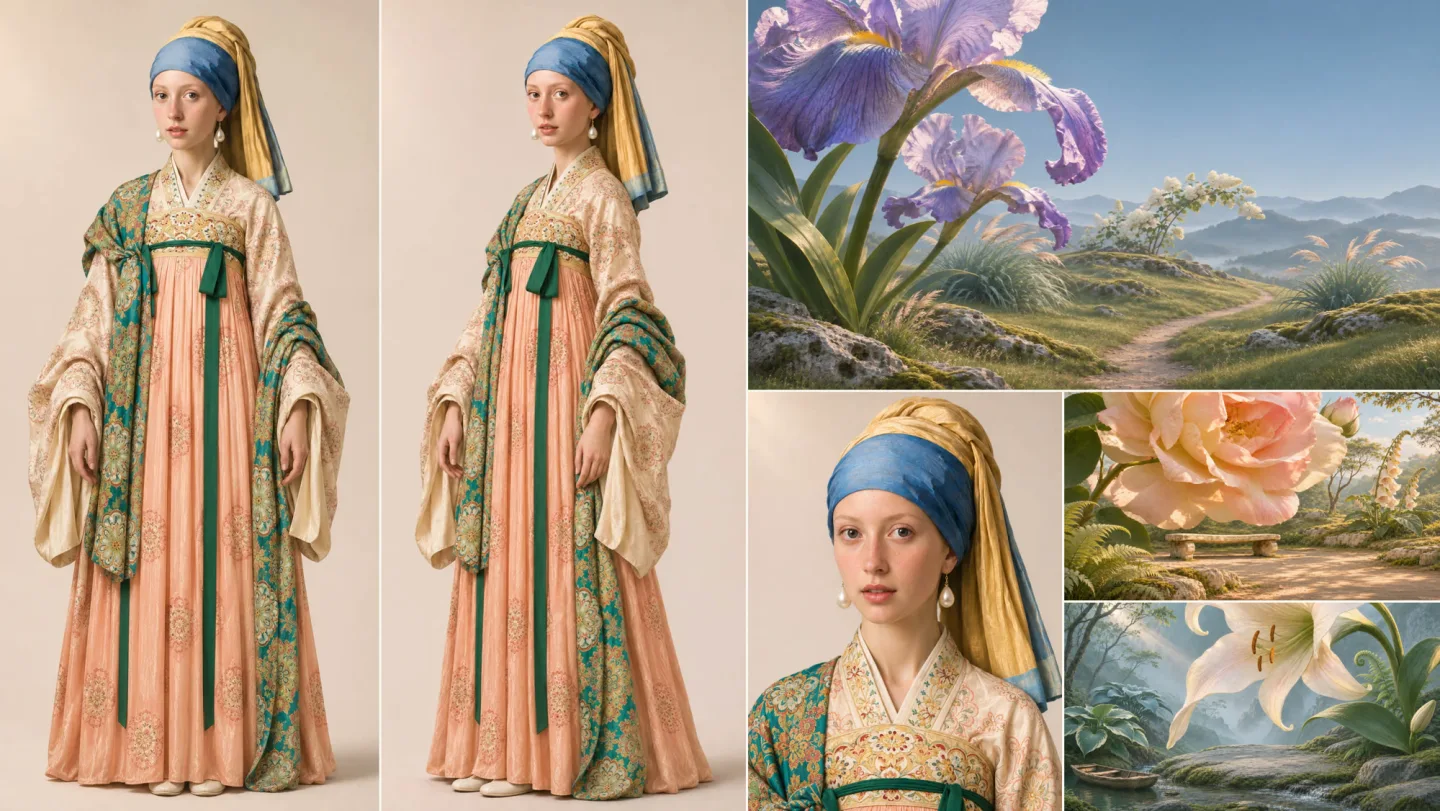
For your own test, label the job of each asset before you write the prompt. A face image is an identity reference. A wardrobe image is clothing. A video may describe movement or shot order, while an audio clip may set a voice or rhythm. If two assets conflict, the model has to guess which one matters. The 20-item limit is a capacity limit, not a recommendation to use every slot.
The separate art-style example and this reference sequence are preserved because they use English descriptions and no Chinese interface text. China-specific performance demos and Chinese-language advertisements in the source reports were deliberately excluded from this edition.
Why does the MoE design matter?
Both versions use a single-stream Transformer with Multi-Head Latent MoE. Text, video and audio tokens share one sequence, so the model can generate movement, lip sync and sound together. A mixture-of-experts model stores many parameters but activates only part of the network for a token. The flagship has about 28B active parameters out of 480B, which is why total capacity and per-token compute are separate numbers.
In a conventional expert-parallel arrangement, a router selects experts and the system sends tokens across GPUs. More selected experts can mean more communication and uneven work between devices. Multi-Head Latent MoE splits each token into independent heads with separate routers and expert pools. The system exchanges fixed-shape activation slices by head ownership first. Routing then happens locally on each GPU.
- Route each token
- Send whole activations across devices
- Run remote experts
- Communication grows with top-k
- Split tokens into latent heads
- Exchange fixed-shape head slices
- Route within each device
- Communication is independent of top-k
Sand.ai reports a roughly 22% training speedup over LatentMoE at 480B under matched total FLOPs and each architecture's optimal configuration. That is a training-system result from the model developer. It does not mean a local generation will finish 22% faster or cost 22% less.
The release also describes a dedicated latent spatiotemporal upscaler. The base model establishes motion and composition at a lower resolution, then the upscaler produces 1080p at 25 fps. Original image references are supplied again during upscaling to help with faces and text. For the Preview, the public inference repository likewise separates a lower-resolution preview stage from a refiner.
What does a Preview installation require?
The official Preview README asks for eight NVIDIA Hopper GPUs, Python 3.12, a recent CUDA toolkit and ffmpeg. A published Docker image is available. The checkpoint download is roughly 307 GB before you account for working space, output video and container layers.
| Preview component | Approximate size | Role |
|---|---|---|
| Preview-stage transformer | 228 GB | Low-resolution denoising |
| Text encoder | 56 GB | Prompt encoding |
| Refiner transformer | 14 GB | Higher-resolution refinement |
| Audio VAE | 5 GB | Audio decoding |
| Video VAE | 3 GB | Video decoding |
| Turbo VAE decoder | 2 GB | Faster video decoding |
The following is the reference path from the official repository, not an installation verified for this article. The checkpoint is downloaded separately. The run script uses the included sample batch, so expect it to consume time and GPU resources.
git clone https://github.com/SandAI-org/MAGI-2-preview.git
cd MAGI-2-preview
pip install -r requirements.txt
pip install huggingface_hub
hf download sand-ai/MAGI-2-preview --local-dir ckpt
bash scripts/run_demo.sh
The README also requires MagiAttention and MagiCompiler. Their revisions are pinned in the Docker build. If you install from source, read those build arguments rather than installing an arbitrary current version. ffmpeg is needed to mux the generated sound into the MP4; without it, the video is written silently.
Short prompts underuse a model trained on long, structured captions. Preview includes optional prompt enhancement through an OpenAI-compatible endpoint. That adds another model service and another potential cost. Leave its API key empty only if you intend to use the raw prompt or provide an already enhanced caption.
Preview does not support the flagship's 30-second mixed-reference workflow. Its released pipeline generates 10 seconds from text or a prompt plus a still image. Check the full model's eventual repository instead of trying to force those inputs through the Preview code.
What should you check when the full weights arrive?
- Confirm the exact repository, model identifier and release date. A name containing MAGI-2 can refer to either the Preview or the flagship.
- Read the weight license and the inference-code license separately. Do not assume the Preview's Apache 2.0 terms carry over.
- Check the actual download size, quantization options, GPU count, memory requirements and supported operating system.
- Confirm whether text-to-video, image-to-video, audio references and editing are all included in the released pipeline.
- Measure output length, frame size, frame rate, audio track and generation time on your own hardware.
- Run one reference-based scene before committing to fine-tuning or private deployment.
For teams that do not need local weights, a hosted workflow may be easier to evaluate first. In the rikoko web app, you can organize a reference-led brief and review available generation choices and estimates before submitting a job. This article does not claim that MAGI-2 or its Preview is integrated.
Can you start hosted before deploying a model?
You can test your references and shot plan in a hosted workflow before reserving GPUs or downloading hundreds of gigabytes of model components. In rikoko, the job estimate shows the expected credits for the model and settings you choose, so you can compare that cost with the time and infrastructure required for a private deployment. Visit rikoko Pricing to review the current video rates and credit options. MAGI-2 and its Preview are not listed as integrations by this article.
Frequently asked questions
Is full MAGI-2 open source now?
Sand.ai has announced a future open release, but the full 480B weights were not present in the model listing checked on November 25, 2026. The current downloadable release is MAGI-2 Preview.
Is MAGI-2 Preview the same as MAGI-2?
No. Preview is a 114B research model with about 6B active parameters and 10-second output. The flagship has 480B total parameters, about 28B active and up to 30-second output with more reference types.
Can I run Preview on one consumer GPU?
The official reference configuration is eight NVIDIA Hopper GPUs. That is the supported starting point documented by Sand.ai, not a claim that every smaller configuration is impossible.
Is Preview restricted to noncommercial research?
The model metadata and companion code repository list Apache 2.0. Your deployment also has to respect the rights attached to your input media and any other components or services you use.
Will the full model need the same eight GPUs?
There is no published full-model local hardware recommendation in the release reviewed. The 480B flagship needs its own deployment documentation; the Preview setup should not be reused as an estimate.
Does MAGI-2 solve visual reasoning?
Sand.ai shows early reasoning behaviors in a pre-trained checkpoint with prompt enhancement off, including Sudoku and narrative completion. It also reports failure cases and says these behaviors became harder to elicit after post-training. These probes are not a general reasoning benchmark.
An English editorial synthesis of Sand.ai's official MAGI-2 release, MAGI-2 Preview repository and model metadata, checked November 25, 2026. Reports by AI Product A Ying, Founder Park and ZPedia supplied additional context and media candidates. Official demonstrations are labeled as such. No local installation or model generation was performed for this review.